


Industrial Minerals Buying Guide: Silica, Calcium Carbonate, Dolomite & Feldspar
- jamshid@alvand
- All Products, Dolomite, Silica, Feldspar, Calcium Carbonate


When buying industrial minerals, the mineral name alone is not enough. Silica, calcium carbonate, dolomite and sodium feldspar are supplied in different forms, particle sizes and mesh grades. Start with your production process, required analysis and particle size; then define packaging, volume and delivery terms.
What do grade, particle size and mesh mean?
Grade describes quality characteristics such as chemical composition, purity, impurities, colour or process behaviour. Millimetre size ranges commonly describe coarser grains, while mesh is used for finer powders. A mesh number alone does not describe the full particle-size distribution or replace a sample test. For industrial purchasing, request an analysis report and test the material in your actual formulation.
1. Silica: premium, industrial, granular and silica fume grades
Alvand Giti lists premium silica labelled 99% purity, grade-two industrial silica labelled 97% with a 1–2 mm size range, and grade-one granular silica at 0.2–0.8 mm. These figures come from the corresponding product listings. For each shipment, confirm the analysis of the selected grade and its delivery terms.
For glass, foundry, ceramics, filtration or construction applications, match both particle size and chemical limits to the production process. Silica fume is a very fine material with different behaviour; it should not be treated as a direct replacement for granular silica simply because the names are similar.

View premium silica specifications
2. Calcium carbonate: granular, micronized and coated
The company lists granular calcium carbonate at 0.2–1 mm and micronized calcium carbonate across mesh 230–2000. Coated calcium carbonate is also relevant where particle surface behaviour matters. Choose among these forms according to mixing equipment, target size, whiteness, impurities and process requirements.
For plastics, masterbatch, coatings, building materials and other uses, one mesh grade will not suit every formulation. Check particle-size distribution, moisture, whiteness and coating type where relevant using a sample. Packaging and tonnage also affect the final quotation and transport.
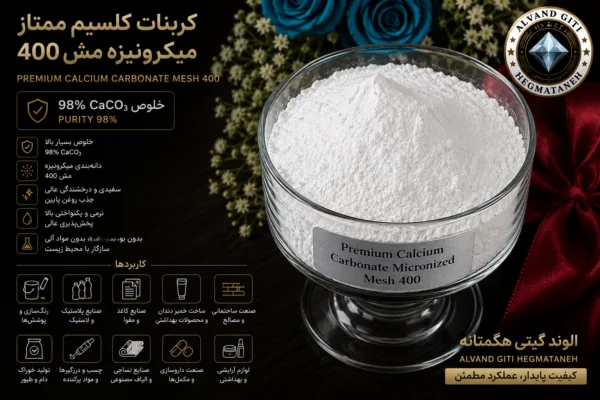
Explore micronized calcium carbonate mesh 230–2000
3. Dolomite: 0.2–1 mm granules and mesh 325 powder
Alvand Giti lists dolomite as 0.2–1 mm granules and micronized mesh 325 powder. Match its composition and particle size to the intended application. In ceramics, glass or building materials, behaviour in the formulation and processing conditions matter; visual similarity between samples is not enough to select a grade.
For a fine-powder process, review mesh, particle-size distribution, moisture and analysis together. For a granular feed, check the size range and the amount of material outside the requested range. Approving a sample before bulk ordering helps avoid a mismatch.

View micronized dolomite mesh 325
4. Sodium feldspar: lump, granular and micronized forms
The company presents sodium feldspar in lump, granular and micronized forms, with a separate listing for micronized mesh 230. For tiles, ceramics, glazes and glass, chemical composition, iron content, fired colour and particle size must fit the formulation and process temperature.
If you have target sodium, iron or whiteness limits, share them with the required mesh, consumption volume and reference sample. Lump or granular material is not automatically suitable for a process that requires ready-to-use powder; match the product form to your milling and mixing equipment.

Explore sodium feldspar and its applications
Bulk purchasing enquiry checklist
For a useful quotation, send these details together: 1) mineral and application, 2) target analysis or impurity limits, 3) millimetre size range or mesh, 4) order volume and buying frequency, 5) bulk, bag or jumbo-bag packaging, and 6) delivery destination and timing. If the grade is undecided, describe the production process and your current reference material.
Final pricing depends on quality, particle size, packaging, order volume and transport. Match the analysis and sample test to your technical requirements before a bulk order; a lower unit price may not reduce total process costs if the material is unsuitable.
Frequently asked questions from industrial buyers
Is mesh 325 always better than a millimetre-sized grade?
No. Finer is not automatically better. Feed form, equipment and the desired process result determine whether a granular or micronized grade is more suitable.
Can a firm price be quoted from the mineral name alone?
An exact price depends on grade, size, quality, packaging, tonnage and destination. Use the same specifications in every enquiry to compare quotations fairly.
Can buyers request analysis and a sample?
Ask the sales team about analysis and sample availability for the selected grade. Final material approval should be based on testing in your actual process.
Where should you start?
If you are deciding between materials or grades, share the application, target specifications and consumption volume. Alvand Giti Hegmataneh can identify available options for quotation and sample review; the buyer should make the final choice after technical evaluation.


