


What Is Coated Calcium Carbonate?
- jamshid@alvand
- All Products, Uncategorized


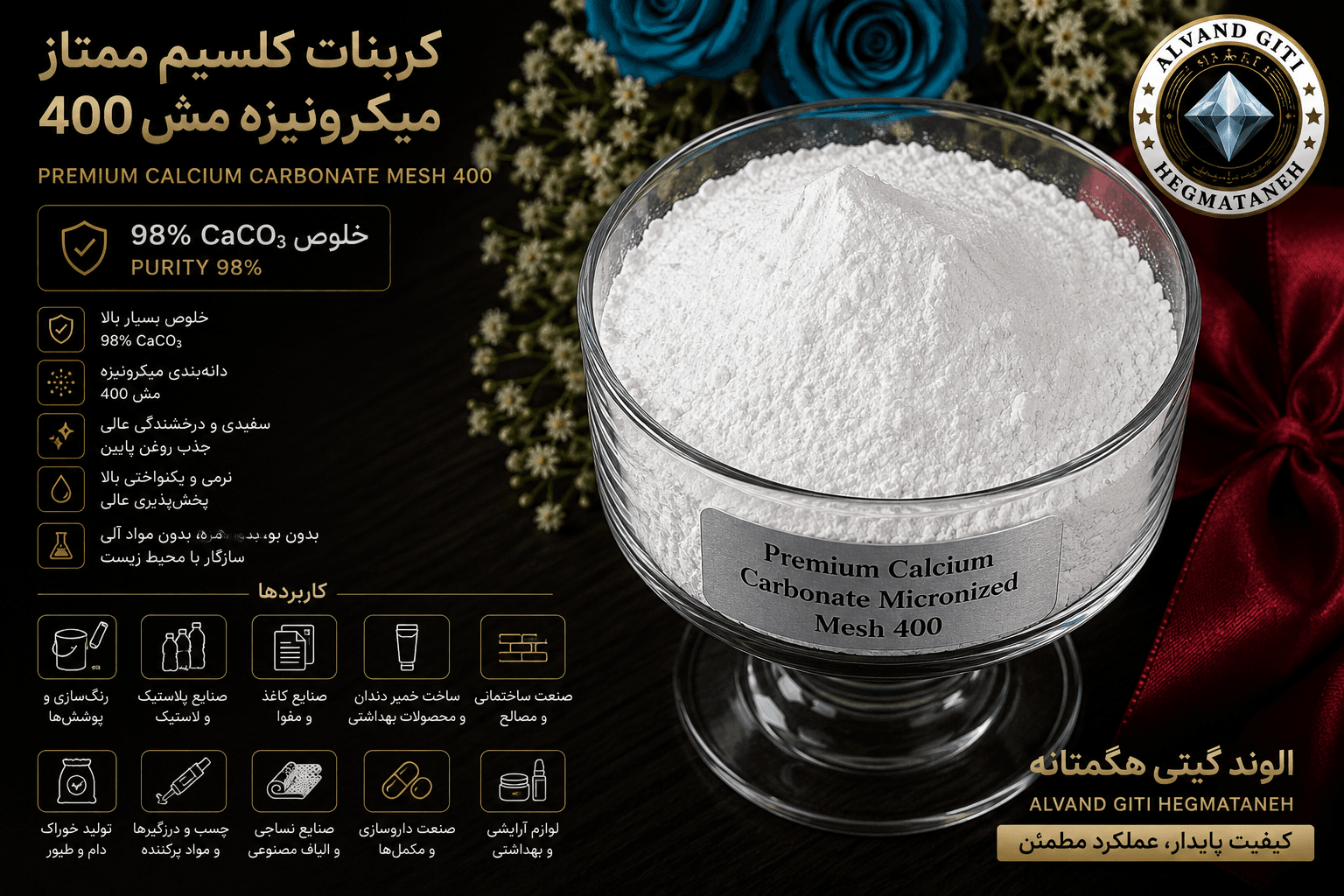
What Is Coated Calcium Carbonate?
Coated Calcium Carbonate Coated calcium carbonate is an industrial grade whose particle surfaces are modified, usually with fatty-acid compounds such as stearic acid. This treatment reduces surface polarity and hydrophilicity and improves compatibility with polymer matrices.
Uncoated calcium carbonate has a relatively hydrophilic surface, while common polymers such as polyethylene and polypropylene are hydrophobic. Surface treatment improves dispersion and reduces particle agglomeration in polymer matrices.Research TUS)
Coated grades are particularly important in plastics, PVC, masterbatch, compounds and related polymer formulations.
Why Is Coated Calcium Carbonate Produced?
Fine particle size alone is not enough; the mineral must disperse effectively in the polymer matrix with minimal agglomeration.
Surface treatment changes the interaction between the mineral surface and the organic phase. Research on thermoplastic composites shows that the treatment method can affect dispersion, interfacial structure and void content.ScienceDirect)
The coated grade should be selected according to polymer type, particle size, coating level, formulation and final-product requirements—not price alone. rather than price per kilogram alone.
7 Benefits of Coated Calcium Carbonate
1. Improved Dispersion in Polymer Matrices
Coated calcium carbonate improves particle dispersion in polymers and reduces agglomeration during mixing.
2. Reduced Surface Hydrophilicity
Stearic-acid treatment reduces surface hydrophilicity and surface energy, creating more hydrophobic behaviour.J-STAGE)
3. Better Compatibility with Hydrophobic Polymers
Surface modification can improve compatibility with non-polar or low-polarity polymers such as PE and PP.Cambridge University Press)
4. Improved Processing in Selected Formulations
In PVC and other polymer compounds, surface-modified calcium carbonate can support improved dispersion and processing.ScienceDirect)
5. Supports Formulation Cost Control
Correct grade selection and loading can help manage raw-material cost while maintaining the required technical performance.
6. Suitable for Different Filler Loadings
Filler loading depends on particle size, coating, base resin, additives, equipment and required final-product properties.
7. Improved Formulation Consistency with the Correct Grade
Industrial buyers should evaluate grading consistency, moisture, brightness, coating type and batch-to-batch uniformity—not CaCO₃ percentage alone.
Applications of Coated Calcium Carbonate
Plastics and Polymer Compounds
Plastics are a major market for coated calcium carbonate. The selected grade must match the resin and final-product requirements. Coated Calcium Carbonate
Typical applications include polymer compounds, injection-moulded products, extrusion and polyolefin formulations.
Filler Masterbatch
In filler masterbatch, surface treatment supports better dispersion and compatibility with the carrier polymer.
PVC
Calcium carbonate is an important PVC filler; particle size and surface treatment can influence processing and selected mechanical or thermal properties.Iris)
Pipes, Profiles and Polymer Components
For pipes, profiles and moulded parts, the grade must match the factory formulation and production process.
Films and Polymer Products
In films, packaging and related compounds, particle-size control and dispersion are especially important.
Chemical surface modification of calcium carbonate particles with stearic acid using different treating methods Applied Surface Science Research TUS)
Coated vs. Uncoated Calcium Carbonate
The principal difference is the surface properties of the particles. is.
Uncoated calcium carbonate retains its original mineral surface, while coated particles are surface-modified to change hydrophobicity, surface energy, flow and compatibility with organic materials.J-STAGE)
Coated material is not universally better; suitability depends entirely on the application.
برای برخی صنایع، کربنات کلسیم معمولی انتخاب صحیح است و در برخی فرمولاسیونهای پلیمری نوع پوششدار عملکرد مناسبتری دارد.
Key Specifications When Buying Coated Calcium Carbonate
Industrial buyers should compare technical specifications and production-line requirements, not price alone.
CaCO₃ Content: Purity of the base mineral.
Particle Size and Distribution: Critical for dispersion and formulation performance.
Coating Type and Level: Indicates the degree of surface modification.
Moisture: High moisture can be undesirable in some polymer-processing applications.
Whiteness and Brightness: Important when appearance and color must be controlled. This should be controlled when product appearance and colour are important.
Quality Consistency: Industrial production requires stable specifications across shipments. Industrial production requires consistent specifications across different shipments.
Packaging and Transport: Must match consumption volume, unloading method and storage conditions.
How to Select the Right Coated Calcium Carbonate Grade
Grade selection should begin with the final product and process requirements.
First define the target industry, base resin, equipment, filler loading, mechanical requirements and process conditions.
For industrial orders, review the analysis report and test a sample before bulk purchasing or changing suppliers. the product analysis and a sample
Alvand Giti Hegmataneh can provide product and supply information according to the customer’s application, specifications and order volume.
Buying Coated Calcium Carbonate from an Industrial Supplier
Price Coated Calcium Carbonate is only one purchasing factor. In B2B orders, quality consistency, continuous supply, technical specifications, application fit, packaging and shipping conditions must also be evaluated.
Alvand Giti Hegmataneh supplies industrial minerals in bulk quantities for manufacturing customers.
an analysis report, specification review, quotation or purchasing advice an analysis report, specification review, quotation or purchasing advice
محصولات مرتبط برای بررسی فنی و خرید
برای مقایسه گرید، دانهبندی و انتخاب محصول متناسب با خط تولید، مشخصات صفحات زیر را بررسی کنید:
- Industrial Calcium Carbonate؛ صفحه اصلی محصول و اطلاعات تأمین عمده.
- Micronized Calcium Carbonate, 230–2000 Mesh؛ مناسب بررسی گریدهای پودری با اندازه ذرات مختلف.
- کربنات کلسیم دانهبندی 0.2 تا 1 میلیمتر؛ برای کاربردهای نیازمند دانهبندی کنترلشده.
- Premium SilicaFor further reading on ceramic materials and technology, consult the specialist resources of the American Ceramic Society. فلدسپات سدیک میکرونیزه Micronized Dolomite؛ سایر مواد معدنی قابل تأمین برای صنایع.
The main difference is surface modification. Coated grades reduce surface polarity and improve compatibility with selected polymer environments.
How does coated calcium carbonate differ from the uncoated grade?
Provide the application, required analysis, particle size or mesh, monthly consumption, packaging type and delivery location so we can recommend the appropriate grade.
What material is commonly used to coat calcium carbonate?
Stearic acid is one of the most widely studied and used surface modifiers for CaCO₃. Its interaction with the surface depends on the coating method and process conditions.PubMed)
Is coated calcium carbonate better for every industry?
No. Coated grades are most useful when compatibility with an organic or polymer phase is required. Uncoated grades may be more suitable for many mineral and industrial applications.
How is the price of coated calcium carbonate determined?
Price depends on base-mineral quality, particle size, coating type and level, packaging, order volume and transport conditions. Accurate quotations require application and quantity details.
Request a Quotation and Analysis Report
Provide the application, required analysis, particle size or mesh, monthly consumption, packaging type and delivery location so we can recommend the appropriate grade.
and send your industry, application, required specifications and order quantity to the Alvand Giti Hegmataneh sales team.
and send your industry, application, required specifications and order quantity to the Alvand Giti Hegmataneh sales team. Coated Calcium Carbonateand send your industry, application, required specifications and order quantity to the Alvand Giti Hegmataneh sales team.
Office: 08133351605
Mobile and WhatsApp: 09183052513
You can also review the technical specifications of our Premium Silica, Industrial Dolomite and Sodium Feldspar products.


